

In coming editorials, I plan to take a look at some of the broadest issues surrounding powder characterization in the pharmaceutical industry. As manufacturing comes under increasing scrutiny I’m going to be exploring whether the sector has the powder characterization tools it needs, in place, to rise to new challenges. However, before I start to consider these bigger questions, I’d like to discuss a topic that provides a useful link: hopper design. Hopper design is clearly a very specific application but for many the associated shear testing methodologies are their first, and for some, only, introduction to the world of powder characterization.
Getting powders to flow consistently from hoppers, at a controlled rate, is an issue for many powder processors. Frequently encountered problems include: erratic flow/stoppages; flooding (uncontrolled flow); segregation and funnel flow/ratholing (flow through the core of the hopper with an outer stagnant layer). Successful hopper operation relies on an efficient match between the in-process material and certain attributes of the hopper: material of construction; half angle (the steepness of incline of the hopper walls); and outlet size. Smoother materials, steeper half angles and larger outlet sizes all tend to promote flow.
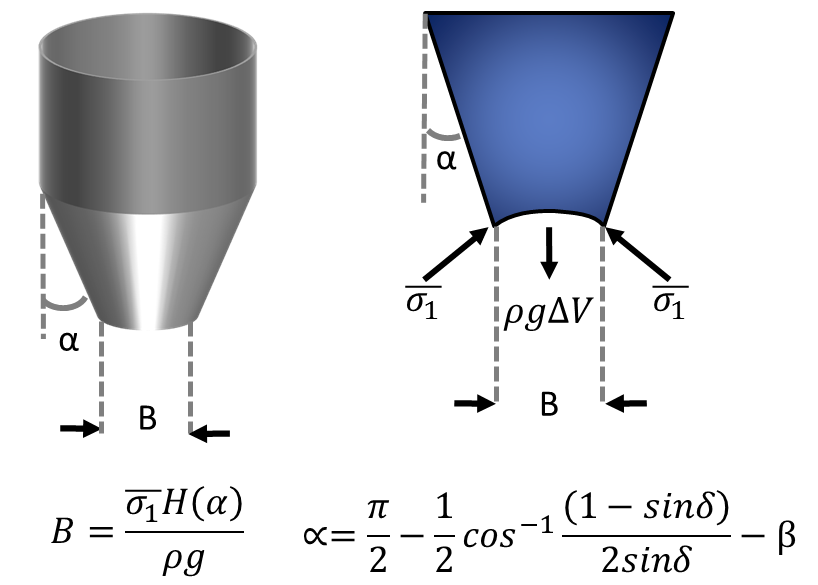
Figure 1 – Hopper Parameters
The hopper design methodology developed by Jenike in the 1960’s remains the standard today. A detailed discussion of it is clearly beyond the scope of this editorial but in summary it relies on calculating two parameters: flow function (FF) and flow factor (ff). FF depends purely on the shear strength of the powder, as determined from shear cell testing, while ff depends also on the characteristics of the hopper – material of construction, and shape. Hopper half angle and outlet size are calculated on the basis of these two parameters.
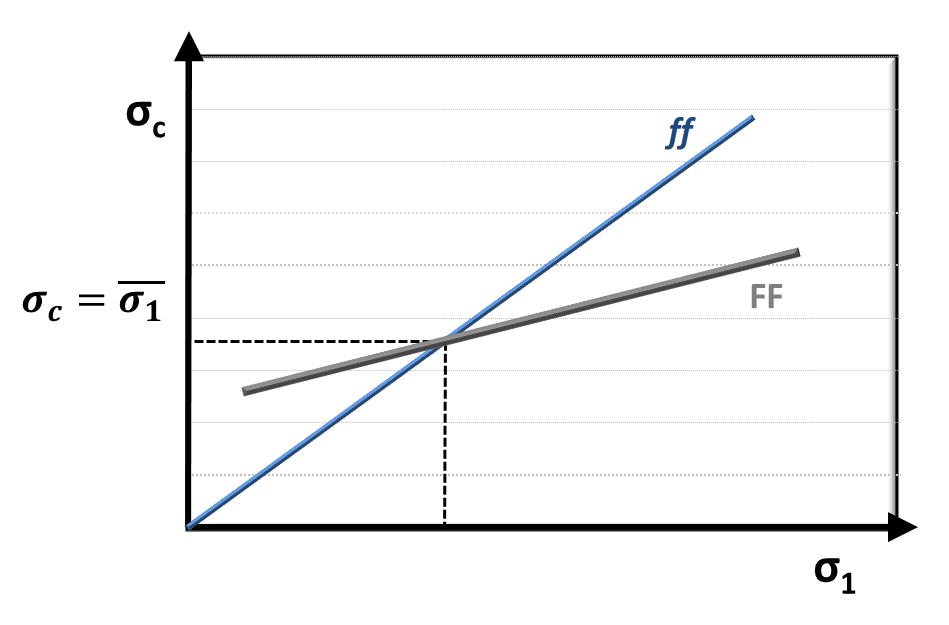
Figure 2 – Flow Function & Flow Factor Plot
Because of these methodologies many believe hopper design to be a relatively secure element of powder handling, and in relative terms it may be. However, operational problems are common, and at many company’s hopper specification is an out-sourced expert task. Why so? Why is that even with defined methods in place robust hopper design remains challenging?
What emerges from Jenike’s methods is that if the material of construction, shape or half angle of a hopper is different from that of another unit then a different outlet size might be needed to achieve mass flow, for the same powder. Equally importantly, using a hopper that works well with one powder to handle an alternative material, may not be successful. These points are relatively well-recognized, but what is less well-understood is that FF and ff, and hence optimal hopper parameters, may change simply because of in-process conditions. For example, if the hopper is filled when the relative humidity is higher than usual, discharge may be compromised. Alternatively, if the powder has the potential to segregate in the hopper then the design may actually need to deal with different and varying powder populations – some fine material and some that is more coarse.
This analysis suggests that keeping hopper design, and the associated testing in-house, may be advantageous. In-house capability makes it easier for engineers to fully scope the conditions over which the design may need to operate, and for troubleshooting teams to get to the root cause of a problem. The barrier is having the necessary expertise, but there are tools that can help. Automated shear testing, coupled with hopper design software, of the type offered by Freeman Technology, guide the user through every step of the hopper design process, from analysis through to number crunching. Using such tools helps powder processors to get the very best out of existing hoppers and specify robust new units with confidence.
Author Biography

























 (All Rights Reserved)