

By Tim Freeman, Managing Director, Freeman Technology

Wet granulation is a routine unit operation within the pharmaceutical industry, and a common precursor to tableting. It is typically carried out as a batch process, with endpoint detection an important issue. Here, dynamic powder rheometry offers proven benefit. By providing sensitive detection of the transition from wet mass to granulate, using a property that is independent of scale, this powerful analytical technique accelerates scale-up and over the longer term improves manufacture.
High shear mixers tend to be the preferred choice for wet granulation. After initial blending of the dry constituents, a solution is added to wet the blend and promote granulation to a desirable endpoint. Control is achieved by manipulating the amount of granulation solution added, the rate of addition, processing time and the impeller speed.
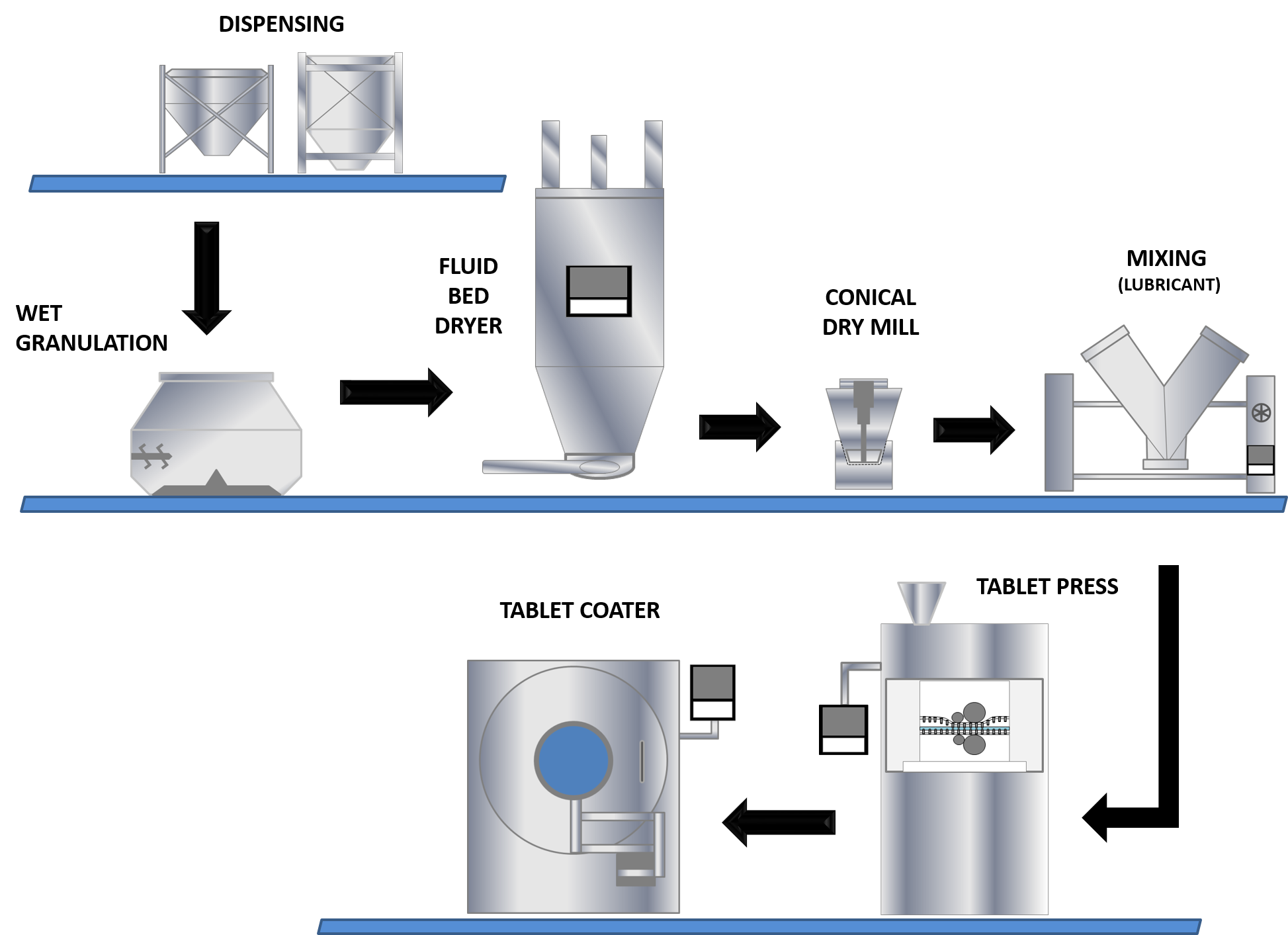
Figure 1 – Wet Granulation Process
Two major issues complicate process development. Firstly, wet granulation is often an intermediate step so determining an optimal endpoint frequently involves working-up a number of batches, through to a final end product. This can be a lengthy process but is essential if the in-process performance of material exiting the granulator cannot be correlated with easily measurable granulate properties.
Secondly, the process variables used to control wet granulation do not scale in a linear manner. For example, a large-scale unit may need a water addition of 27% instead of the 24% required by a pilot scale process in order to reach the same endpoint. Having, and using, a direct measure of granulation endpoint, throughout the development cycle is, for both these reasons, advantageous.
Basic Flow Energy (BFE) is a dynamic powder property measured using a powder rheometer. Monitoring BFE during the course of a wet granulation allows efficient tracking of the process. At low granulation solution levels, BFE remains approximately constant but as the mass becomes wetter, a sharp increase is observed. Image analysis of samples extracted around this point of increase confirms that the sharp rise corresponds directly with the transition from wet mass to granules. The rapidity of the rise makes BFE extremely sensitive at this most crucial part of the process, providing an opportunity for very precise endpoint definition.
For a new wet granulation process, BFE monitoring quickly identifies the operating region of interest. Working up a number of batches made under different conditions within this region precisely sets a target BFE, one that exactly defines an optimal granule. This procedure associates an optimum granule with a BFE value rather than a set of processing conditions, thereby defining a relationship that is independent of scale. The link between BFE and final product quality therefore needs only be established once for each formulation, not at every scale.
This BFE gives a direct measure of granulation endpoint for all subsequent development work. As the process moves towards commercialisation, new conditions can be established relatively quickly, at each stage, to meet the target BFE. Furthermore, over the longer term, operating the process to a BFE endpoint, rather than with preset parameters, introduces the potential for adaptive control, allowing the operator to manipulate variables to maintain a consistent output even when feed varies. In this way the use of powder rheometry supports not only the faster development of an optimal granulation process, but also more flexible and efficient manufacture across the lifetime of the product.
Tim Freeman, Managing Director, Freeman Technology
Read More
























 (All Rights Reserved)