

Introduction
Oncolytic therapies, drugs which trigger cancer cell death, lysis, and an immune response, have been regulatory approved for just under two decades, globally. The pipeline is vast, however so far only five drugs in this class of therapies have been approved by regulatory agencies across the world. In this article the approved drugs will be discussed and a few of the most promising candidates in phase III clinical trials.
Regulatory Approved Therapies
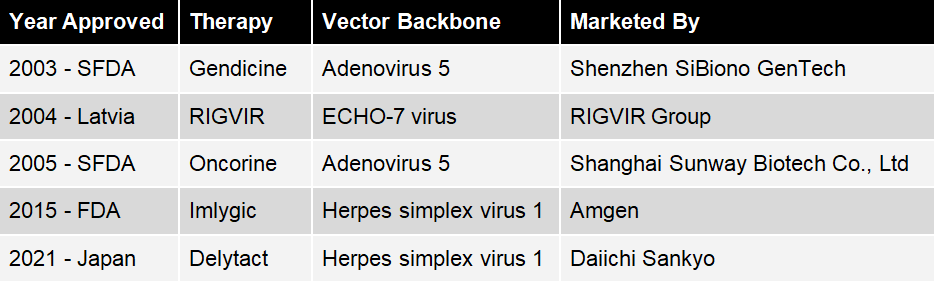
Table 1: Regulatory approved oncolytic agents.
Gendicine
In 2003 Gendicine, produced by Shenzhen SiBiono GenTech, was approved by the State Food and Drug Administration of China (SFDA) for head and neck squamous cell carcinoma (HNSCC) [1]. It is a replication-incompetent, recombinant, serotype 5 human adenovirus (Ad5) engineered to contain the human wild-type p53 tumor-suppressor gene. It was considered a world-first in gene-therapy at the time.
Gencidine has been a clinical and commercial success. In 2018 it was reported that cumulatively a total of 169,571 vials, containing 1.0 x 10¹² vector particles each, had been administered to more than 50,000 patients. One injection is given per week for four to eight weeks. Among those patients about 5,000 were international, from over 50 nations outside of China [2]. Over 66 million US$ in sales have been accrued, the cost of each dose reportedly being around US$ 387 [3].
RIGVIR
Originally developed in the 1960s, in 2004, RIGVIR was approved by Latvian regulatory authorities and was recently approved in Georgia. Currently manufactured by the RIGVIR Group, it is an oncolytic, non-pathogenic, unmodified ECHO-7 virus, originally adapted for melanoma [4]. On May 31st 2019 the State Agency of Medicines in Latvia suspended the licence for RIGVIR, due to substandard manufacturing resulting in lower than advertised virus titres per vial [5].
Oncorine
In 2005 the SFDA approved a classic (replication competent) oncolytic virotherapy called Oncorine for HNSCC, which was developed by Shanghai Sunway Biotech Co., Ltd [6]. Oncorine is an Ad5 with an E1B and E3 gene deletion. The development in the USA of a very similar virus called Onyx-15 was halted at the outset of a phase III trial due to a funding crisis. This funding crisis led to a ten year lag behind China in the approval of an oncolytic virus.
Oncorine is injected intratumorally, 1-3 vials (5.0 × 10¹¹ ~ 1.5 × 10¹² virus particles) per day, combined with 5-FU and cis-pla-tin chemotherapies. It has not been approved in the USA.
Im-ly-gic
In October 2015, the US food and drug administration (FDA) approved Im-ly-gic, for the treatment of melanoma in patients with inoperable tumors [7]. It was developed by BioVex, Inc. and taken to market by Amgen. In Jan 2016 it was approved in Europe for some inoperable melanoma [8]. According to reports it is also available in China [9].
Im-ly-gic is a herpes simplex virus 1 (HSV-1) based oncolytic vector delivered via injection. It was generated from a fresh isolation of HSV-1 virus (JS1) and has a GM-CSF replacement of the two copies of the ICP34.5 gene which normally reverses the interferon induced phosphorylation of the α subunit of the eukaryotic initiation factor 2 (EIF2S1) [10]. The interferon pathway is usually disrupted in cancer thus lending the vector specificity to cancer cells.
It was launched at US$ 65,000 per patient. It is not priced equally in every region. Germany’s Federal Joint Committee (G-BA) published an unfavorable final decision on the early benefit assessment of Im-ly-gic, and the price was halved. That said, the health technology assessment (HTA) in the UK was far more favorable, with NICE recommending the treatment.
Delytact
In June 2021, Japan’s Ministry of Health, Labour and Welfare (MHLW) granted conditional approval to Daiichi Sankyo’s Delytact, a triple-mutated, replication-conditional HSV-1 for the treatment of malignant glioma [11]. It ...
































 (All Rights Reserved)