

Repurposing drugs is not new to the pharmaceutical industry. There are numerous effective therapeutic agents whose side effect profiles have been documented over long-term use in clinical settings that are potential candidates for repurposing. Moreover, substantial costs and slow pace of new drug discovery and development, repurposing of 'old' drugs to treat both common and rare diseases is increasingly becoming an attractive proposition because it involves the use of de-risked compounds, with potentially lower overall development costs and shorter development timelines. In fact, approximately two-thirds of new drug applications submitted to the FDA are for modifications of existing drugs or their indications.(1)Classic life-cycle management of a branded drug often includes extending the value and life of the drug by innovative strategies such as reformulation, finding new indications, or rediscovering the inherent value of an old drug, all of which are intended to provide added benefit to patients.
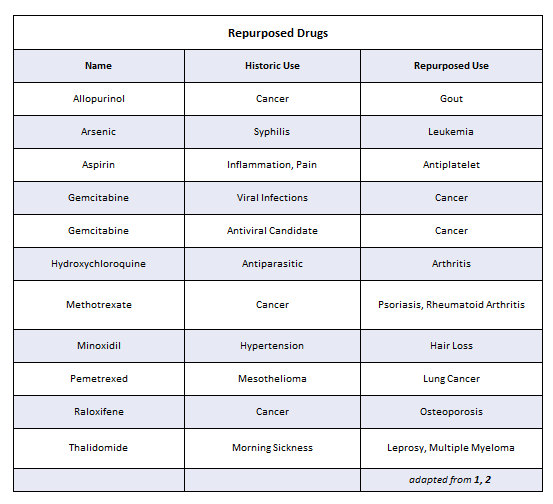
Repurposed Drugs
New applications or indications for drugs can be discovered systematically using sophisticated computer programs or serendipitously by noting unexpected, but beneficial, side effects of treatment. In some cases, targets of a known drug that are clinically relevant in one biologic pathway or disease may be relevant in other pathways or diseases as well. It is also possible to take advantage of drugs that interact with multiple targets by developing a new indication where a secondary target is more relevant. A partial list of well-known repurposed drugs is shown in Table 1.
Older drugs that have been overshadowed by advances in new drug development technologies, such as rational structure-based drug design and high-throughput screening (drug discovery experimentation that uses automated systems), may be revitalized when newer drugs either do not live up to their therapeutic potential or elicit an increased risk-to-benefit ratio over time.
Many medical and surgical supplies may benefit from new and innovative technologies that improve drug delivery systems, such as chewable tablets, oral liquids, or conversion of intravenous to non-injectable forms of delivery. For example, a different route of administration, such as conversion from oral to transdermal, may lower the dose required, permit a new indication, or reduce toxicity. Conversion to extended-release technology decreases the dosing frequency, which may increase adherence and decrease side effects by altering intestinal absorption.
Recent Repurposed Drugs
2020 alone has already seen an extensive amount of FDA approvals for repurposed drugs. The COVID-19 pandemic saw the initial repurposing and then warned against use hydroxychloroquine as a potential indication for treatment of the virus due to the risk of heart rhythm problems as announced by the FDA late April,(1) having stated no significant improvements observed related to its use. A list of recent drugs that have been repurposed is given below:(3)
Imbruvica Capsules and Tablets
Braftovi (encorafenib) Capsules
Reblozyl (luspatercept-aamt) for Injection
Imfinzi (durvalumab) Injection
Triferic (ferric pyrophosphate citrate)
Taltz (ixekizumab) Injection
Eucrisa (crisaborole) Topical Ointment
Epclusa (sofosbuvir and velpatasvir) Tablets
Ofev (nintedanib) Capsules
Nerlynx (neratinib) Tablets
Procysbi (cysteamine bitartrate) Delayed-Release Capsules
Voltaren Gel (diclofenac sodium) Topical Gel
Ajovy (fremanezumab-vfrm) Injection
Dificid (fi...
Read More





























 (All Rights Reserved)