
Cloud endoscopy system using NTT's high-speed, low-latency IOWN APN technology
Highlights:
● NTT's IOWN APN technology and Olympus' advanced technology for endoscopes will be utilized in a demonstration experiment of a cloud endoscopy system that enables real-time image processing of endoscopes on the cloud.
● Through this demonstration experiment, the two companies will establish a reference model for the commercialization of a cloud endoscopy system and contribute to overcoming current limitations of endoscope processing performance and improving maintainability, as well as flexible and rapid response to the market.
NTT Corporation (NTT) and Olympus Corporation (Olympus) today announce that the two companies have jointly begun a demonstration experiment of a cloud endoscopy system that enables image processing on the cloud.
This cloud endoscopy system utilizes Olympus' advanced technology for endoscopes to perform image processing, which has been conventionally processed within the endoscopic equipment, on a remote cloud. This has been difficult to achieve with conventional network technology. NTT's IOWN APN technology1,2 makes it possible to process images in real-time on the cloud. Through this demonstration experiment, the two companies will establish a reference model for the commercialization of the cloud endoscopy system, overcome the current limitations of processing performance of endoscopic equipment, improve maintainability, and provide a flexible and rapid market response to the market.
1. Background
An endoscope is a medical device in which a flexible tube is inserted into the natural openings of the body to perform an examination and obtain tissue samples. Instances where endoscopes can be utilized are increasing year by year due to the equipment’s low level of invasiveness and high level of safety, and the technology is becoming increasingly sophisticated.
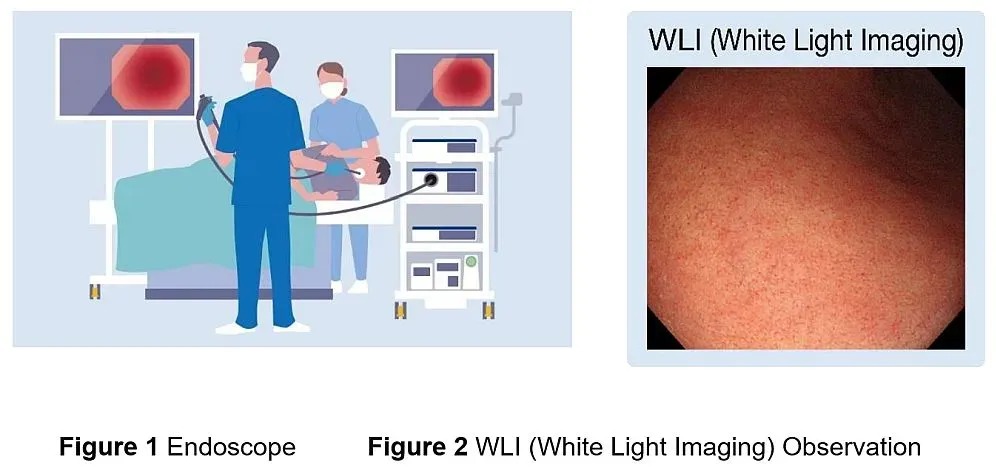
When the endoscope was first introduced, it was a revolutionary device that allowed users to view the inside of the body in real time. Since then, it has progressed even further by supporting highdefinition images, introducing Narrow Band Imaging (NBI) using optical technology, and enabling the collection of samples simultaneously with observation. Recently, advanced support functions have been introduced, such as displaying potential lesions to the operator from the images taken by the endoscope, contributing to the early detection of lesions with greater safety and certainty.
Currently, endoscopes have performance and maintenance limitations. In addition, it is expected that more cases in the future will require flexible feature improvements and updates based on new user needs, such as real-time remote diagnosis and treatment. Therefore, there is discussion on cloud computing endoscopes, in which some functions with a high processing load, such as image processing, can be done in the cloud.
By sharing the processing load with GPUs on the cloud built-in data centers, users can receive the latest functions through software updates on the cloud and enable real-time remote diagnosis and treatment by sharing video information among multiple hospitals.
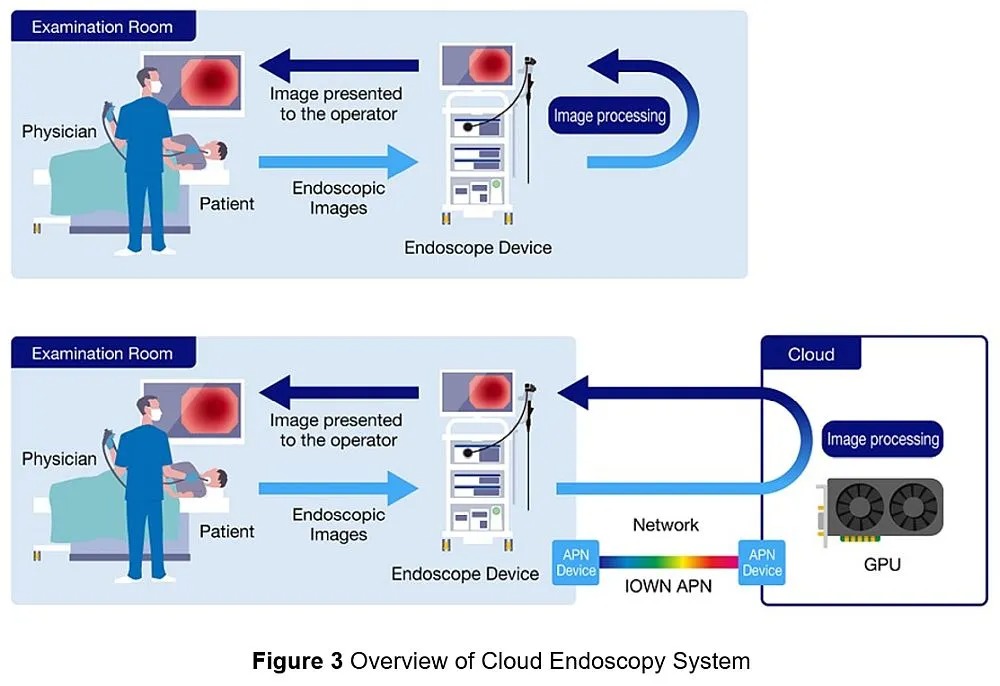
In addition to transitioning existing systems to the cloud, major network-related technical challenges include:
Realizing a high-speed, low-latency network with no delay between the endoscope and the cloud. Conventional networks require a long data transfer time which is unfavorable for the physicians.
Ensuring the high-quality connectivity required for medical endoscopes by promptly detecting abnormalities, such as network failures that would make the cloud unavailable, and providing minimum functions locally in such cases (fallback function).
Implementing advanced security measures on the data transfer path that are difficult even for quantum computers ...

![benzoic acid, 2-[[(2-cyano[1,1-biphenyl]-4-yl)methyl]amino]-3-nttor-methyl ester](https://eimg.pharmasources.com/img_Cphi_en/Product/2017_08/Mimg_1708180243913806.jpg)
























 (All Rights Reserved)