

Drug development is high risk and lengthy. The wait for potential new treatments is hard for patients, particularly those with rare or hard-to-treat conditions, and if the market is small, the cost of the approved drug may be high. Repurposing and repositioning existing drugs (also known as reprofiling) can speed up the process and cut the required financial investment compared with new drugs, ensuring that patients can get access to treatments more quickly and at more affordable costs. [1, 2]
There are four key groups of repurposed drugs – marketed drugs under existing or expired patents, drugs that have been terminated at clinical or regulatory stages, stereoisomers or metabolites of existing drugs, or candidates where minor changes have been made to existing drugs. It’s important to remember that drug failure in clinical trials isn’t just caused by efficacy or safety issues – it can be because a company changes direction, problems with formulation, or because there have been issues with commercial interest or poor strategic planning. [3]
The benefits of repurposing and repositioning drugs
While the two terms are often used interchangeably, drug repurposing can refer to taking an approved drug and using it for another indication. Drug repositioning can refer to restarting development of a drug that stalled, to gain approval for a new indication. [1]
The primary benefits of repurposing or repositioning drugs are the cost and time aspect. The time frame for developing a repurposed drug is typically one to three years, compared with an average of 12 years for a novel drug. [4]
For a company developing a drug that has stalled in development, or one that has reached the market for another indication, the ability to ‘recycle’ the existing preclinical and/or clinical safety, toxicity and pharmacokinetics/pharmacodynamics data will save both money and time. It also allows them to recoup the money invested in what might otherwise be a failed drug. The existing knowledge also reduces the risk of failure.
Drugs that have failed or are failing in development but still have some patent protection may be repositioned for another indication by the originator company or a licensee. Repurposing can also allow companies to extend the lifecycle of their own marketed drugs that are approaching patent expiration, as they can gain protection for the new indication. Repurposing and repositioning drugs can also be valuable for companies developing drugs for rare diseases, by encouraging collaboration, and the sharing of data and resources. [3, 5]
The steps for developing and gaining approval for a repurposed drug can include:
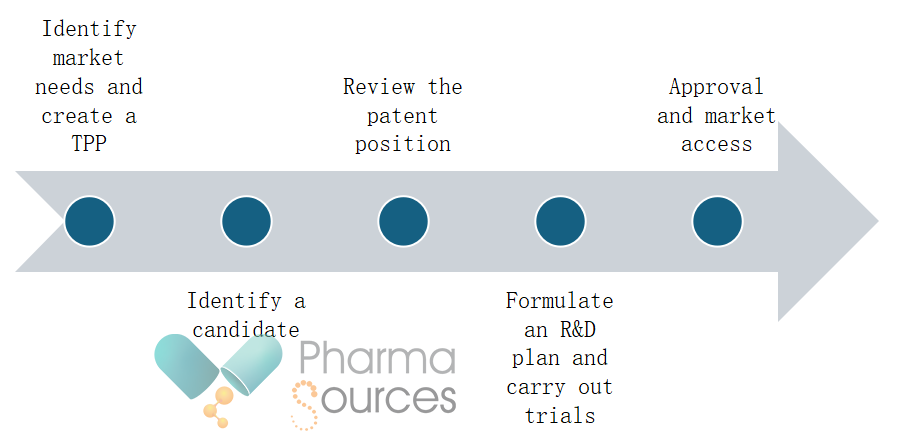
Identify market needs and create a target product profile
For a company that wants to repurpose a drug but doesn’t have an existing candidate in mind, the first step is to evaluate the market landscape to see whether there is a patient need for a new drug and whether the company will be able to recoup the investment in drug development. This is supported by developing a target product profile (TPP). The TPP describes the desired characteristics of a drug in development for a specific disorder. It provides the company with a guide throughout drug development for all the teams involved. [2, 6, 7]
Areas covered in a TPP, which are also useful to review when a company has a specific candidate in mind, include: [2, 7, 8]
●Indication
○Initial target indication
○Potential future indications
●Population
○Initial target market – economic priorities or areas of greatest unmet need
○Study feasibility
○Requirement for a companion diagnostic to identify sub-populations
●Targeting/pharmacokinetics
●Safety, tolerability and efficacy
○Study endpoints
○Benefits compared with current/future competitors or standard of care
●Drug-drug interaction...
































 (All Rights Reserved)