
Recently, Xynomic Pharmaceuticals announced that it has made key progress in clinical trials for three different indications of HDAC inhibitor with the potential of "Best in class", Abexinostat, and two of which are the best data in the world.
1. Phase I clinical trial of Abexinostat in combination with the BTK inhibitor Ibrutinib of Janssen in the treatment of mantle cell lymphoma in the United States has been successfully completed, and the complete response rate(the proportion of cases where the tumor completely disappeared) achieved was up to 71%, indicating the best complete response rate in the world.
2. The US FDA approved Abexinostat as the first-line or second-line drug in the treatment of renal cancer, which is a revision of phase 3 protocol for global registration. Previously, the Phase I clinical study data of Abexinostat in combination with Pezopanib in the treatment of renal cancer showed that the median overall survival (mOS) in patients with renal cancer is 27.65 months, which is the best data in the world for the treatment of renal cancer.
3. The Phase I clinical trial of Abexinostat in combination with Temozolomide in the treatment of recurrent glioma (GBM) has been initiated. Preclinical study has shown that Abexinostat can efficiently cross the blood-brain barrier, and the effect was promoted by Temozolomide to enhance the efficacy of Temozolomide and improve the survival rate of glioma patients.
Abexinostat is a new specific HDAC inhibitor with GBM characteristics, which is being applied for national class 1 new drug, and it is mainly used for the treatment of lymphoma and renal cancer. Xynomic Pharmaceuticals has the rights and interests in the exclusive global development, production and commercialization of Abexinostat.
The anti-tumor mechanism of HDAC inhibitor
Histone deacetylase (HDAC) inhibitor are a new class of drugs developed based on the theory of epigenetics. As the basic unit of chromatin of eukaryote, Nucleosome affects the function of cells by modification of the acetylation, methylation, phosphorylation and ubiquitism of the N-terminal of histone core. The dynamic equilibrium between histone acetylase (HAT) and histone deacetylases (HDAC) can control the chromatin structure and gene expression. When the deacetylation level of histone increases, the acetylation level relatively decreases, which can result in the changes in normal cell cycle and metabolic behaviors and induce tumors and neurodegeneration. HDAC inhibitor targeting HDAC can regulate the acetylation of histone, promote the transcription and expression of anti-tumor transcription factors, regulate the related signal pathways and exert anti-tumor biological effects by inhibiting the HDAC activity. Studies have shown that HDAC inhibitor can exert an anti-tumor effects by promoting cell differentiation, blocking cell cycle, inducing apoptosis, and up regulating the expression of tumor suppressor gene such as p21cip/WAF.
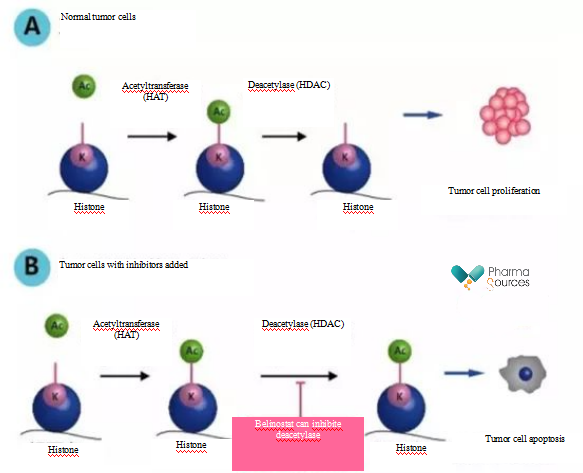
Research progress on HDAC inhibitors
As a mature anti-tumor target, HDAC inhibitors are currently mainly used for blood diseases, and most products are undergoing clinical trials for new indications such as breast cancer, non-small cell lung cancer, pancreatic cancer. With further study, the range of indications may be increased.
Currently, there are a total of 5 HDAC inhibitors approved for market worldwide. Vorinostat, Romidepsin, Belinostat, and Panobinostat are approved by the US FDA for marketing in the clinical treatment of peripheral T-cell lymphoma, cutaneous T-cell lymphoma, and multiple myeloma; Chidamide (brand name: apsara®) is approved for marketing by NMPA in China and used for peripheral T-cell lymphoma and breast...





























 (All Rights Reserved)