
Recently, Ikiorensai Injection, a BCMA targeting CAR-T product jointly developed by IASO Bio and Innovent, was approved for marketing in China for treating the adult patients with recurrent or refractory MM. It is the third CAR-T product approved in China and the ninth CAR-T product approved in the world.
To date, it has been nearly 6 years for global CAR-T therapy since Kymriah was approved in 2017. In terms of sales volume, the global CAR-T market has increased from US$10 million in 2017 to nearly US$2.7 billion in 2022.
Gilead has become the largest winner. Yescarta's sales volume reached US$1.16 billion last year, becoming the first famous CAR-T product. And there have been 3 kinds of CAR-T product in China in two years since Fosun Kite's Yescarta was approved in 2021. Within two years of approval, the annual revenue of JW Therapeutics' Beinuoda was CNY 146 million in 2022, with a year-on-year growth of 373.1%. Although the sky-high price of CNY 1.2 million a needle has frequently returned to hot search, the commercialization of CAR-T in China still brings the market some expectations under the situation that domestic medical insurance payment is stretched.
However, it is a pity that although there have been great breakthroughs in CAR-T therapy in several indications in the field of hematologic tumor and there have been famous products in five years, we all know that the prevalence rate of hematologic tumor is not high, which the annual increase of patients with hematologic tumor in the world accounts for less than 10% of all new tumor patients. In other words, there is imagination space left for the market, but not big.
So where is the wide market space? The answer is the field of solid tumors. The solid tumor is one of the two most deeply developed fields in CAR-T therapy, thus it is extremely urgent to overcome solid tumor in CAR-T therapy, considering domestic market access policy and current biomedical capital environment. Excellent clinical data on hematologic tumor also bring expectations to patients. In recent years, it is time to turn over the mountain of solid tumor for CAR-T.
01 Progress in clinical development of solid tumors: For scattered target, China and America go ahead
According to the data, CAR-T exploration on solid tumor is still in the early stage. By the end of last year, there were 249 clinical trials registered in NIH in America, among which clinical research is basically in the early research stage (Phase I/II), and the distribution of targets is also extremely scattered, including GPC3, GD2, EGFR, MSLN. MUC-1, HER-2, PSMA and so on. Among them, the most CAR-T products are targeting MSLN and GPC3, which account for more than 20% of all clinical trials.
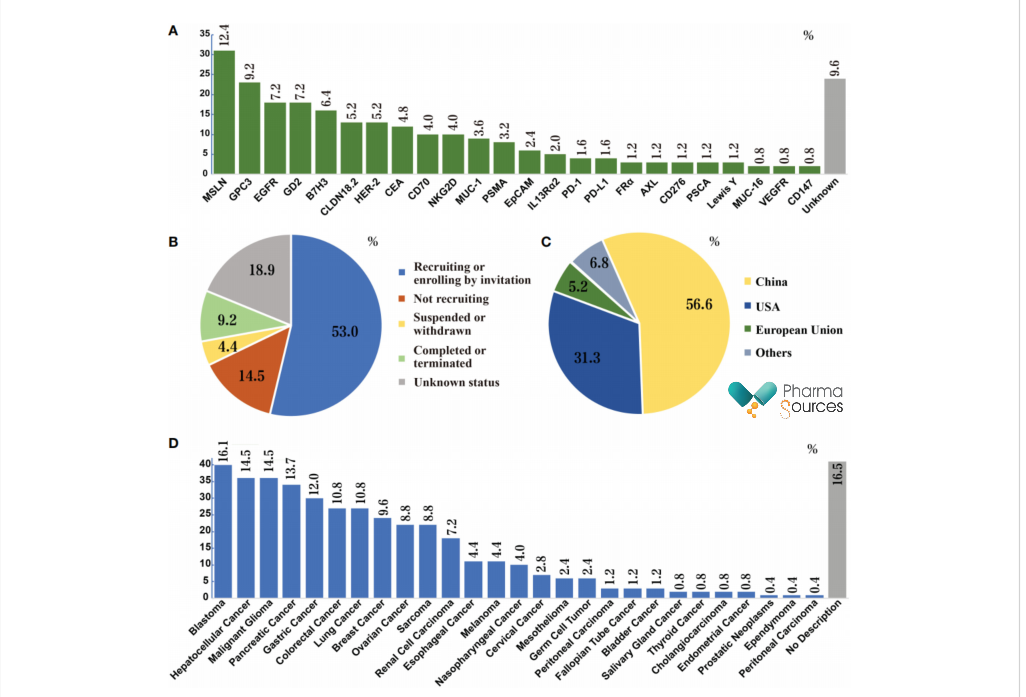
From the figure, it is not difficult to find that China is currently the most active country which explores CAR-T on solid tumors, with clinical trials exceeding the general proportion. For the indications, at present, the most exploration of CAR-T in solid tumors is blastoma (16.1%), hepatocellular carcinoma (14.5%) and malignant glioma (14.5%), while the exploration in major cancer types is slightly conservative: gastric cancer (12.0%) and lung cancer (10.8%).
Take MSLN as an example, it is a differentiation antigen existing in normal mesothelial cells, with no clear biological function in normal tissues, but the current evidence shows that MSLN has potential significance in tumor cell adhesion, progress, proliferation, survival and chemotherapy resistance. MSLN is overexpressed in many solid tumors, and CAR T cells targeting MSLN have been taken clinical...




























 (All Rights Reserved)