

ABSTRACT: This article, which is Part 3 and the concluding part of the series on continuous manufacturing focuses on CM in China and adoption of CM for biologic products.
Continuous Manufacturing in China
CM had been progressing in China both from companies as well as CDMO side.
In 2021, Henlius, a global biopharmaceutical company setup in 2010, successfully launched China's first continuous manufacturing clinical production workshop1 to achieve end-to-end continuous production and thus improving productivity with stable and controllable quality.
In 2021, Shanghai Pharmaceuticals enlisted Syntegon Technology to build a laboratory for continuous manufacturing technology in China2. The facility would be dedicated to the promotion and application of the new technology in the field of innovative drugs and provide new ideas and accessible experimental platforms for the development of orphan drugs. Syntegon's continuous manufacturing platform works by dosing, mixing, and granulating sub-quantities of the desired product-called X-Keys-that continuously run through the manufacturing chain before being removed. Those X-Keys allow traceability of ingredients, an essential element for pharmaceutical production. Another appeal of the platform is that it doesn't require technology transfer or scale-up.
In the CDMO space, WuXi AppTec was one of the first movers in the CM space. WuXi STA, a subsidiary of WuXi AppTec started building its flow chemistry capability in 2014. In 2022, WuXi STA, opened a new continuous manufacturing (flow chemistry) plant at its Changzhou campus in China for large-scale active pharmaceutical ingredient (API) and advanced intermediate production.3 The plant features 11 continuous production lines which support 20 types of challenging reactions, including low temperature metallo-organic reactions, photochemical reactions, high-temperature & high-pressure reactions, nitration reactions, ozonolysis, etc. WuXi STA now has multiple flow chemistry R&D labs and 25 continuous manufacturing lines in Shanghai Waigaoqiao, Shanghai Jinshan, and Changzhou sites in China.
In Jan 2023, WuXi STA also opened its first continuous manufacturing (CM) line for oral solids is in operation at its drug product site in Wuxi city, China.4 This line focuses on continuous direct compression equipment with the unit operations including dispensing, blending, lubrication, tablet compression, and coating. Process Analytical Technology (PAT) has been implemented within the CM line to monitor blending uniformity, allowing for real-time analysis and control during production to ensure high product quality.
CM in Biologics
Continuous manufacturing (CM) has been a goal for the pharmaceutical industry for several years. While small molecule drug substances and drug products have achieved this in many cases, biologics are behind the global implementation of CM because of their more complex manufacturing processes.
A recent report5 indicates that the demand for continuous bioprocessing is increasing, and expenditures in both upstream and downstream continuous bioprocessing equipment are among the top three new expenditures by the companies surveyed.
Continuous manufacturing of biologic products has several promising "paradigm shifts" that make the prospect attractive to many organizations6. Table 1 provides a real-world example of the benefits of moving to a continuous manufacturing platform. Improvements in facility area reduction, increase in upstream productivity, downstream column size reduction, and reduced buffer usage are just some of the benefits that can be realized when continuous biomanufacturing is implemented.
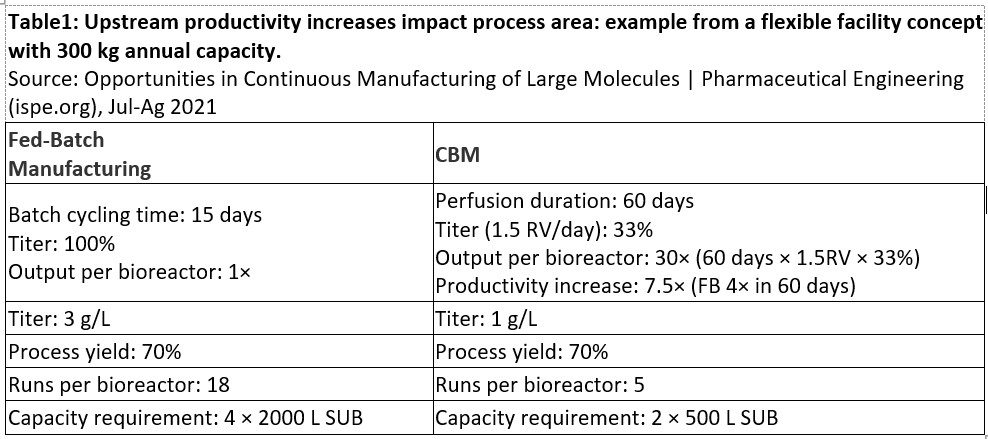
Abbreviations: RV, reactor volume; FB, fed batch; SUB, single-use bioreactor.
A key driver of continuous manufacturing implementation is the opportunity to reduce the cost of goods. Continuous biomanufacturing allows organizations t...
























 (All Rights Reserved)