

PROLOGUE
Continuous Manufacturing, an innovation in the manufacturing field has been gaining importance over the last few years, as drug products have been getting approved by regulators over the world and reaching the market. This series of three article on this topic reviews this important topic.
The first article provides an outline of the subject and highlights the advantages of continuous manufacturing and shows how innovative drug companies and generic drug companies are approaching continuous manufacturing.
The second article focuses on the manufacturing of Active Pharmaceutical Ingredients (API’s) and drug products using the continuous manufacturing technique and some of the challenges associated with continuous manufacturing.
The third article shows the definition of batch in continuous manufacturing, its importance from a regulatory perspective, the importance of linking it to control strategies and why continuous manufacturing presents a major shift for quality systems. It also reviews the global regulatory landscape associated with continuous manufacturing.
CONTINUOUS MANUFACTURING- PART 1
ABSTRACT: This paper presents an outline to the topic of continuous manufacturing. It outlines the applicability of technique from development to commercial manufacturing and the potential benefits of adopting continuous processing technologies for by companies involved in the manufacture of both, innovative and generic pharmaceutical products. Finally, it highlights some of the issues faced by generic companies while adopting continuous manufacturing technique.
INTRODUCTION
As a concept, continuous manufacturing has been around for certain industries like oil and gas for a very long time and manufacturing is run in a continuous mode. However, in case of the pharmaceutical industry, continuous manufacturing has emerged as an innovation in the manufacturing space in the past decade and a half. This innovation has the potential to improve flexibility, speed, and robustness in the manufacture of pharmaceuticals. As is the case with deployment of any new technology, there have been apprehensions from a technological, commercial, and regulatory point of view. However, with the passage of time and products being approved on the global market, this technology has been gaining acceptance globally.
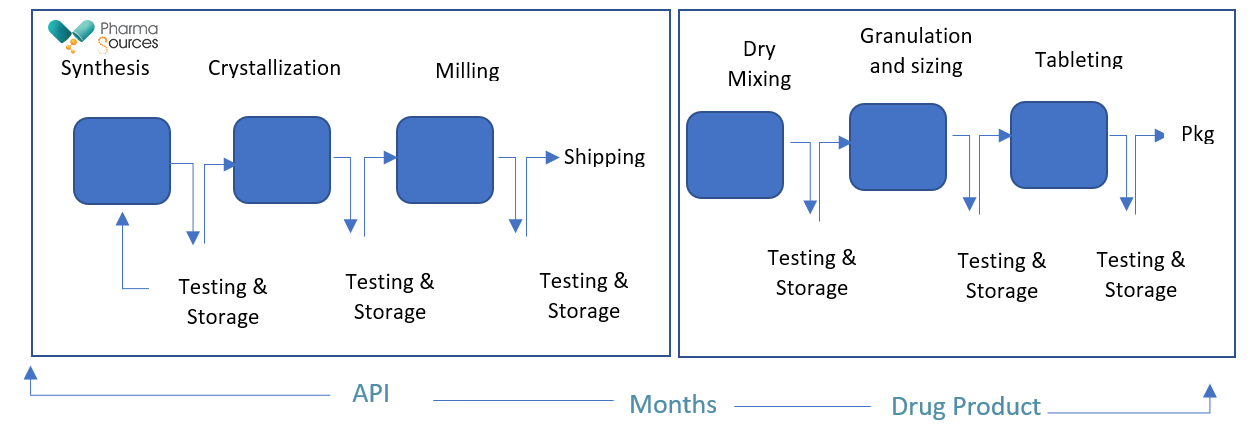
Traditionally, the manufacture of pharmaceuticals followed a batch process, both in case of API and drug product manufacturing. Fig. 1 shows the representative unit operations in batch process of manufacturing
Fig. 1: Batch Manufacturing process
(Schematic adapted from “Modernizing Pharmaceutical Manufacturing:
from Batch to Continuous Production S. Lee et al., J. Pharm. Innov., 2015”)
Based on the number of unit operations and capabilities available at site of manufacturing, the entire process of manufacturing from API to drug product can take a few days to a few months1. In this, the product is collected after every unit operation, tested offline after every operation, because of which actual processing time can vary from a few weeks to few months.
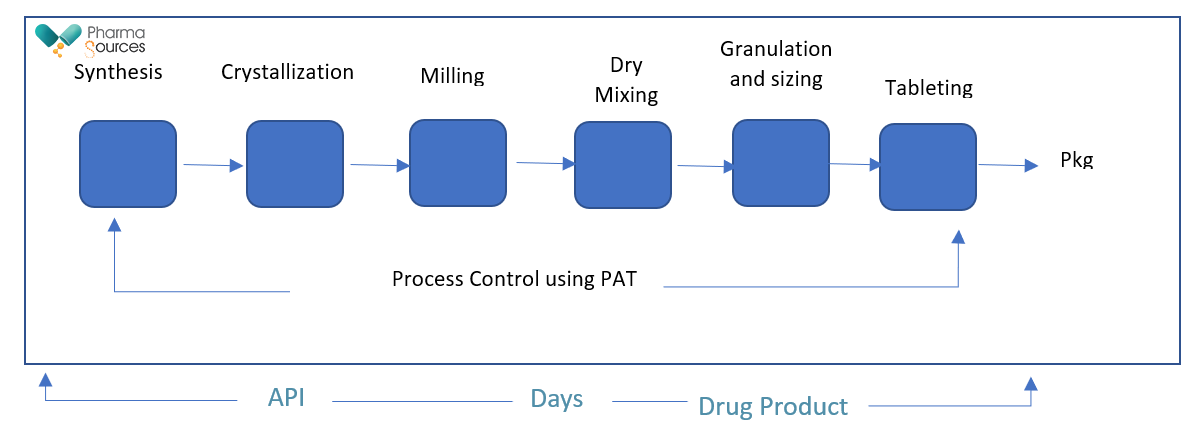
Comparatively, the manufacture of pharmaceuticals following a continuous manufacturing process, both in case of API and drug product manufacturing is shown below in Fig. 2 reflecting the unit operations.
Fig. 2: Continuous Manufacturing process
(Schematic adapted from “Modernizing Pharmaceutical Manufacturing:
from Batch to Continuous Production S. Lee et al., J. Pharm. Innov., 2015”)
At one site 1) Using smaller equipment 2) Shorter supply chain
In a continuous process, the material(s) and product are continuously charged into and discharged from the system, respectively, throughout the duration of the process. Using small...

























 (All Rights Reserved)