
In recent years, as competition in the generics market intensifies and R&D costs for innovative drugs continue to rise, modified new drugs have emerged as a crucial development direction for the global pharmaceutical industry. The United States has accumulated substantial experience through its 505(b)(2) pathway, while China has witnessed rapid growth in applications and approvals since establishing clear registration categories for modified new drugs in 2016. This article integrates successful practices from the United States 505(b)(2) pathway to analyze China's policies and regulations, acceptance/approval status, and R&D Status for modified new drugs, while exploring existing challenges and future optimization direction.
1. Overview and Market Experience of the United States 505(b)(2) Pathway
1.1 Path definition and classification
The United States 505(b)(2) pathway, originating from the 1984 Hatch-Waxman Act, aims to provide a simplified approval process for products that involve modifications to the dosage form, formulation, indications, or other aspects of already marketed drug active ingredients. According to FDA classifications, it covers 10 categories of registration applications including new dosage forms (Category 3), new combinations (Category 4), and new indications (Category 6).
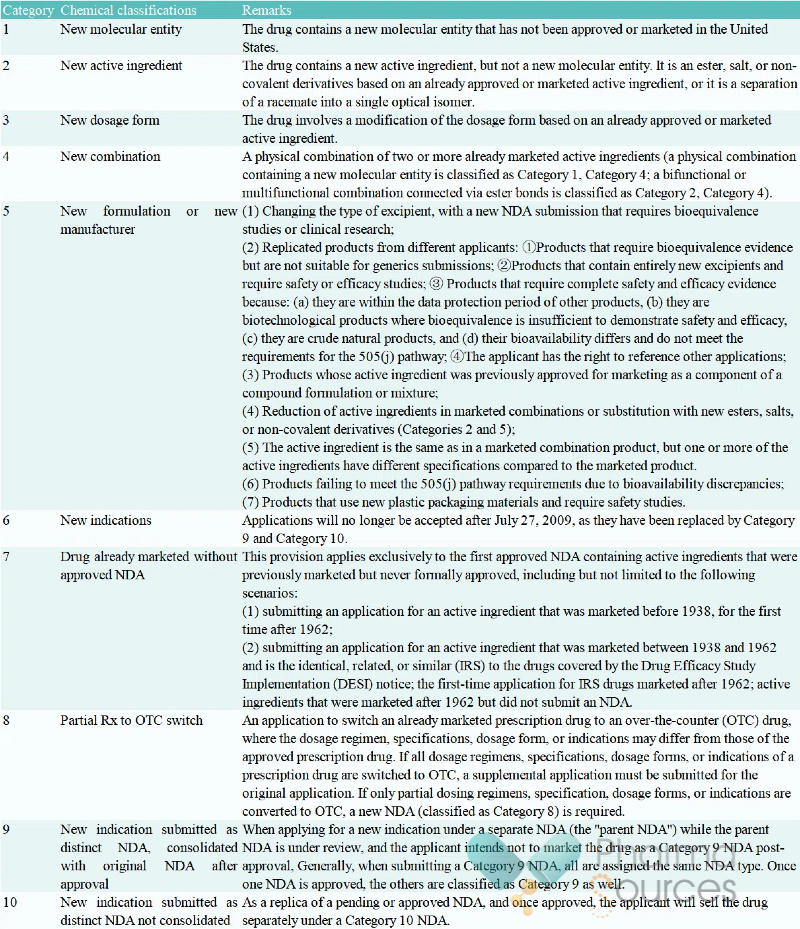
Source: Manual of Policies and Procedures
The United States New Drug Application (NDA) Registration Classifications for Pharmaceutical Chemicals (Image Source: China Food and Drug Administration)
1.2 Market performance
Market Scale: As of 2023, over 2,500 products under the 505(b)(2) pathway have been approved in the United States cumulatively, with 2022 sales volume reaching USD 105 billion, accounting for 17% of the pharmaceutical market.
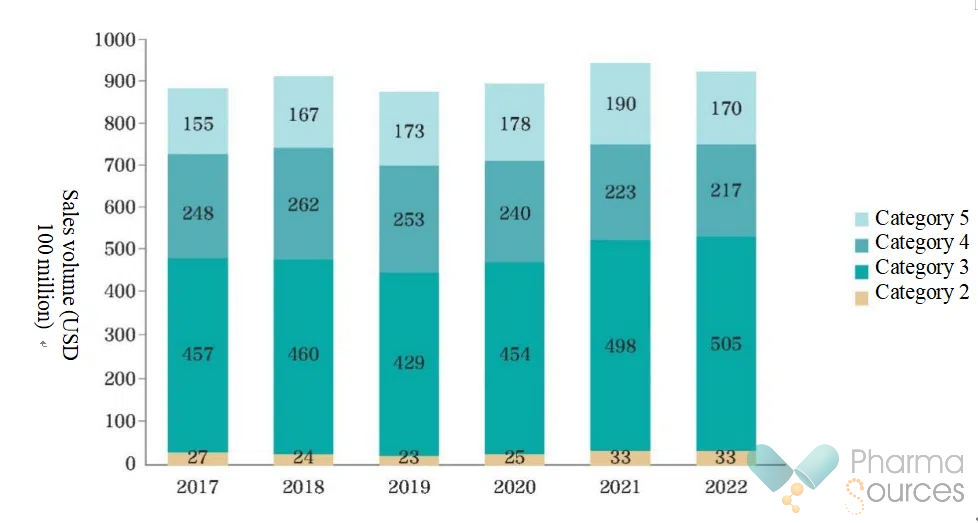
Market Sales Volume for United States Categories 2-5 505(b)(2) Products from 2017 To 2022 (Source: China Food and Drug Administration)
1.3 Success factors
Creative design: Restasis addresses dry eye disease through immunomodulatory mechanisms.
Technological barriers and patent protections: Complex preparations (such as leuprorelin microspheres, octreotide microspheres) have a long lifecycle due to the high difficulty in generic formulation.
Clinical advantages: Such as liposomes doxorubicin reducing cardiotoxicity and albumin-bound paclitaxel enhancing efficacy.
Precise market positioning: Originator enterprises extend the product lifecycle through brand extensions, such as the risperidone orally disintegrating tablet.
1.4 Review characteristics and challenges
Efficiency of review: An average review cycle is of 18.4 months, with 30% of approvals relying on clinical pharmacology data.
Market concentration: The top 50 products constituting 72% of total sales volume, dominated by originator enterprises, while small and medium enterprises face promotion and healthcare access pressures.
2. China's modified new drugs policies and regulations, regulations and registration classification
2.1 Policy evolution
In 2015, the country launched a drug approval reform, and in 2016, the Pharmaceutical Chemicals Registration Classification Reform Work Plan first clarified the definition of modified new drugs (Category 2), requiring that they "demonstrate clear clinical advantages". The 2020 Drug Registration Management Measures refined accelerated pathways including priority review and conditional approval.
2.2 Registration categories and requirements
Category 2.1: New active ingredients (such as isomers or new salts) must demonstrate clinical advantages.
Category 2.2: New dosage forms and new formulation processes must be validated through bioequivalence or clinical trials.
Category 2.3: New combination formulations emphasize the synergistic effects of the components.
Category 2.4: New i...





























 (All Rights Reserved)