

I. Introduction
Helminths are a diverse group of parasitic worms that belong to the phylums Platyhelminthes (flatworms), Nematoda (roundworms), and Acanthocephala (thorny-headed worms). Soil-transmitted helminths are responsible for parasitic infections in as much as a quarter of the human population worldwide. [WHO, 2012] The following is a brief overview of these three major categories of helminths:
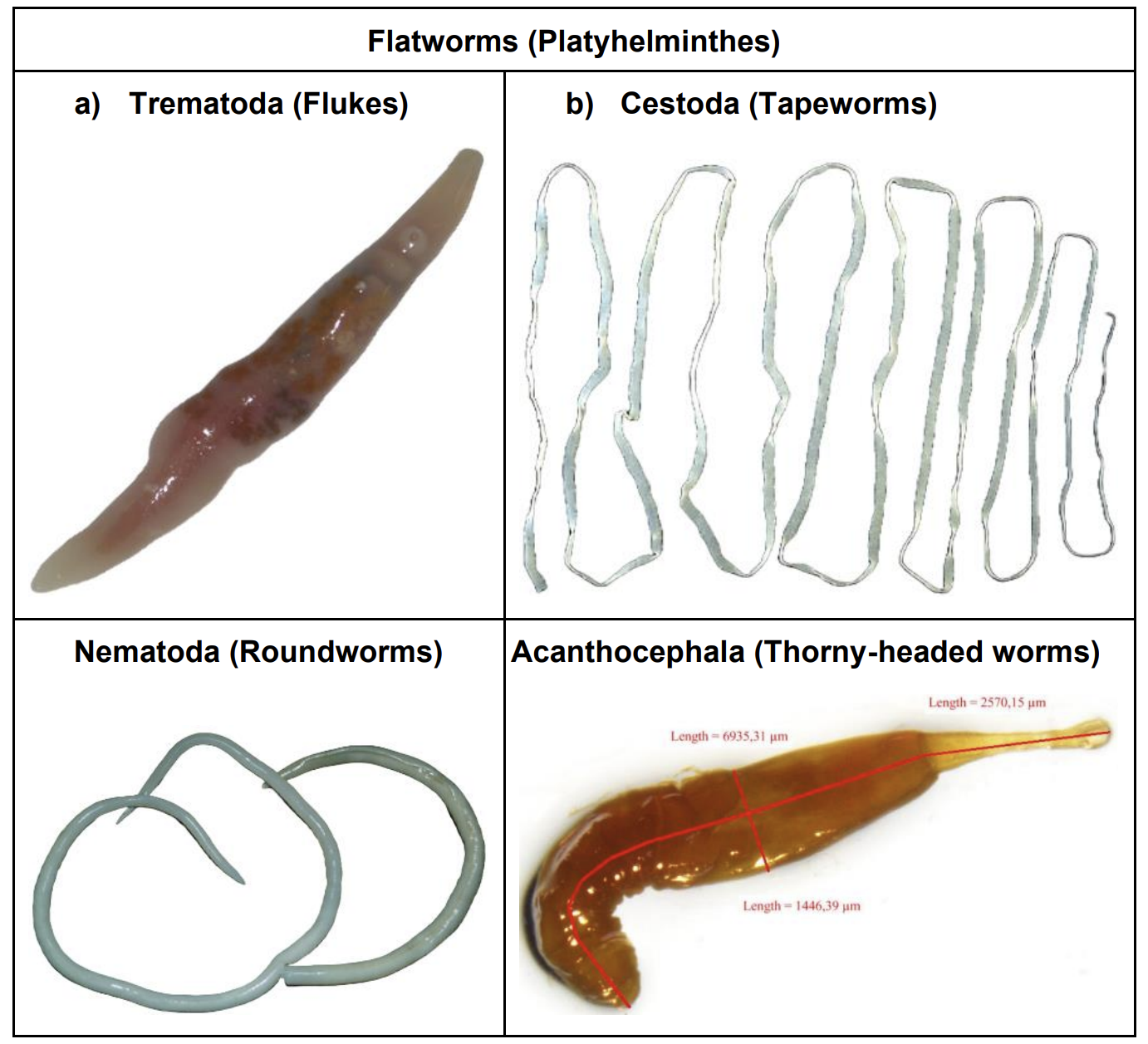
Figure 1: The three phyla of helminths (Platyhelminthes, Nematoda, and Acanthocephala). Acanthocephala do not typically infect humans. Panel a) Botulus microporus, which lives in the intestines of lancetfish. The image was originally curated by the Wikipedia user Anilocra. b) an adult Taenia saginata beef tapeworm. The image was originally curated by the US Centers for Disease Control and Prevention (CDC). Lower left panel: adult Ascaris lumbricoides worms. The image was originally curated by the Sustainable Sanitation Alliance (SuSanA). Lower right panel: Acanthocephala originally posted by Zlatko Nedi? on ResearchGate.
Flatworms (Platyhelminthes)
There are two main types of flatworms, namely Trematoda and Cestoda. Trematodes, commonly known as flukes, are flatworms characterized by their flattened, leaf-like bodies. They typically have complex life cycles involving multiple hosts, including snails as intermediate hosts. Examples of flukes include the Schistosoma spp., which causes the disease schistosomiasis, also known as snail fever, bilharzia, and Katayama fever.
According to the World Health Organization (WHO) at least 251.4 million people were estimated to require preventive treatment for schistosomiasis in 2021, out of which more than 75.3 million people were reported to have been treated. [WHO, 2023]
Cestodes, or tapeworms, are ribbon-like flatworms that inhabit the intestines of their hosts. They lack a digestive system and absorb nutrients directly through their body surface. Examples of cestodes include Taenia spp., responsible for diseases like taeniasis and cysticercosis.
Roundworms (Nematoda)
Nematodes, commonly referred to as roundworms, have elongated, cylindrical bodies. They are one of the most diverse and abundant groups of animals on Earth. Some nematodes are free-living in soil and water, while others are parasitic. Parasitic nematodes can infect a wide range of hosts, including humans, causing various diseases. Examples of parasitic nematodes include Ascaris lumbricoides (causing ascariasis), Trichuris trichiura (causing trichuriasis), and Enterobius vermicularis (causing enterobiasis). (Nemaplex, 2022)
Thorny-headed worms (Acanthocephala)
Thorny-headed worms, or acanthocephalans, are parasitic worms characterized by a retractable proboscis with spines or hooks at its tip. They use this proboscis to attach to the intestinal walls of their hosts. Acanthocephalans are unique among helminths in this respect. While they primarily infect animals, including fish and birds, they can occasionally infect humans through the consumption of infected intermediate hosts. (Tikkanen, 2010)
Life Cycle
The typical life cycle of a helminth often involves several stages: (Libretexts, 2022)
a) Egg Stage: The life cycle begins with the production of eggs by adult female helminths. These eggs are often passed out of the host's body through feces.
b) Larval Stage: Once in the environment, the eggs hatch into larvae. These larvae may develop further and can vary in form, such as miracidia, cercariae, or filariform larvae, depending on the type of helminth.
c) Intermediate Host (if applicable): In some helminth species, the larvae must go through an intermediate host, like a snail, fly, fish, pig or cow, where they develop and multiply.
d) Infective Stage: After undergoing necessary transformations, the larvae become infective to the definitive host, which is the host where the adult helminths will ultimately...



































 (All Rights Reserved)