
The China Pharmaceutical Industry Association (CPIA) released the Notice on Doing a Good Job in Active Pharmaceutical Ingredient (API) and Intermediate Production and Supply ("Notice") on Mar. 28 to suggest that based on the effective prevention and control of the epidemic, association member units resume work and production ASAP and accelerate production and supply to meet the Chinese and international market demands. The Notice provides the "draft list of priority products subject to shortage monitoring due to production interruption of APIs and intermediates in China" of the WHO to guide the orderly capacity recovery in China.
The WHO declared that the COVID-19 entered the pandemic stage on Mar. 11, and many European and American countries have entered the rapid outbreak period with the rate of progress faster than expected. According to the epidemic announcement on Mar. 29, the number of confirmed cases worldwide has exceeded 650,000, with the number exceeding 10,000 in many countries in Europe, North America, and Asia. Globally, the R&D of therapeutic drugs and prophylactic vaccines still needs time, and each country can only rely on the prevention and control method of early diagnosis and early isolation.
Pharmaceutical product shortage and imbalance between supply and demand of global APIs
The global API supply industry chain has been affected since the outbreak of the COVID-19 epidemic. Countries such as India and the U.S. have experienced pharmaceutical product shortage to varying degrees; in particular, the capacity and supply of epidemic-related drugs are insufficient. The Indian government announced on Mar. 3 that the export of 26 APIs and drugs prepared therefrom, including paracetamol, etc., would be restricted and first supplied to meet the domestic demands of India due to the serious damage caused to the supply chain by the novel coronavirus; on Mar. 6, Trump required all the production of all medical protective articles and antibiotics, etc. to return to the U.S.
In the meantime, the COVID-19 epidemic has been raging in the world. To meet the anti-epidemic needs, countries and regions all over the world are urgently purchasing and reserving necessary supplies, and the demands for urgent anti-epidemic supplies including antiviral and anti-infectious APIs, etc. have increased largely.
The demands for pharmaceuticals, a special product, are relatively rigid. With interruptions in the supply chains of intermediate pharmaceutical products and APIs, etc. overseas, the API supply-demand structure has become unbalanced under the global anti-epidemic background.
Global API supply pattern
According to the data of the U.S. consulting company Markets and Markets, the global API market size was about USD180 billion in 2019 and is estimated to reach USD245 billion in 2024, with a compound annual growth rate of 6.1%.
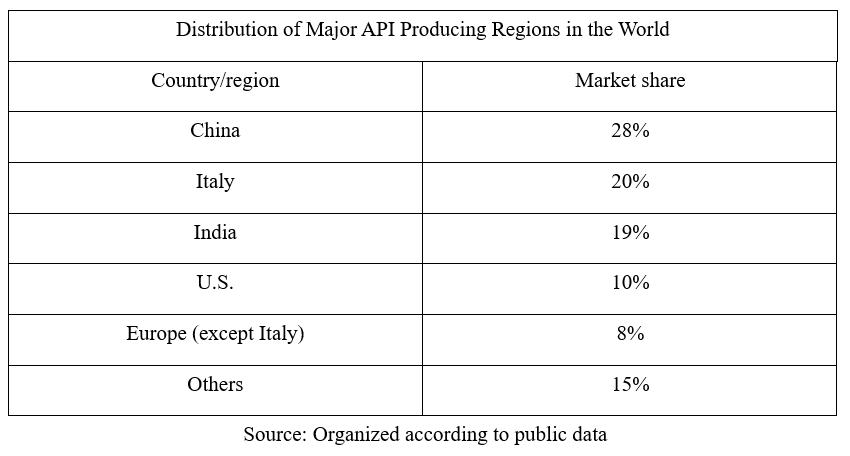
Before the epidemic, major API producing regions in the world included North America, Western Europe, and China, India and Japan in Asia; wherein, North America was based on import, most of the supply in Japan was to local formulation enterprises, while Western Europe, China and India were major export bases of APIs.
In this epidemic, Italy has become the hardest-hit country in Europe and has expanded the lockdown to the entire country on Mar. 10, directly affecting the daily supply of the related API production bases; the domestic supply is insufficient in India and the U.S. As a result, the supply of overseas APIs has been facing a challenge.
API capacity gradually recovering in China
The API industry chain in China was interrupted temporarily after the outbreak of the COVID-19 epidemic, and global related anti-epidemic drugs including antibiotics and antiviral drugs, etc. were in short supply, especially antibiotics and vitamins. The 26 APIs and drugs restricted by the Indian government for export are mainly antibiotics, vitamins, and antiviral and antipyretic and analgesic drugs of which the APIs or core intermediates are from China...






























 (All Rights Reserved)