
Recent reports have indicated that the National Medical Products Administration has addressed the potential carcinogenicity associated with CAR-T cell immunotherapy. It has been recommended that the risk of secondary malignant tumors be included in the precautionary section of the medication's instructions.
In a parallel development, the United States Food and Drug Administration (FDA) has also issued statements concerning the risks associated with CAR-T therapy.
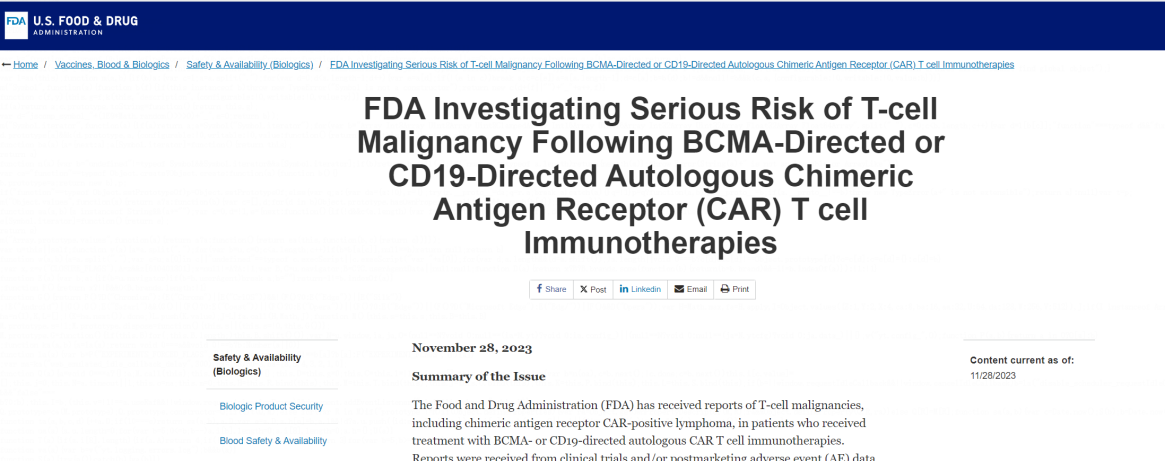
In November 2023, the FDA disclosed that it had received reports of T-cell malignancies in patients treated with BCMA or CD19 targeted CAR-T cell immunotherapies. According to the FDA, the risk appears to be relevant to all currently approved BCMA-targeted and CD19-targeted CAR-T Cell Immunotherapies. This document provides an analysis of this risk.
▲The Essence of CAR-T Antitumor Therapy
CAR-T therapy (Chimeric Antigen Receptor T-cell Therapy) represents a novel cancer treatment modality, wherein a patient's T cells are engineered to express targeted chimeric antigen receptors (CARs). This procedure involves harvesting the patient's T cells, subjecting them to genetic modification to produce CAR-T cells, which are then expanded, cultivated, and reintroduced into the patient. Once administered, CAR-T cells are capable of identifying and eliminating cancer cells with high specificity, thereby reducing collateral damage to healthy cells. Despite the success of CAR-T therapy in treating specific types of leukemia and lymphoma, its application may be accompanied by side effects, including cytokine release syndrome (CRS).
▲Inherent Safety Risks of CAR-T Therapy
While CAR-T therapy has demonstrated remarkable efficacy in the treatment of leukemia and lymphoma, it is not devoid of medicinal safety risks. Cytokine release syndrome (CRS), a common side effect, manifests as a systemic inflammatory response, potentially leading to symptoms such as fever and hypotension. Neurotoxicity represents another potential concern, with possible symptoms including headaches and increased intracranial pressure. Additionally, the excessive proliferation of CAR-T cells could lead to persistent cell growth or even the emergence of T-cell malignancies. The risks associated with immune reactions and infections also warrant attention. Patients undergoing CAR-T therapy typically require close monitoring, necessitating hospitalization and medication, thereby enabling healthcare professionals to implement tailored interventions based on the individual's condition.
▲Why Treatment for Cancer Might Induces New Cancers
The possibility of CAR-T cell therapy inducing T-cell malignancies can be elucidated through the general pharmacological mechanism of action of CAR-T cell therapy. CAR-T cell therapy involves the genetic modification of a patient's T cells to express Chimeric Antigen Receptors (CARs) that target cancer cells. These modified CAR-T cells, upon reinfusion into the patient, are capable of recognizing and attacking cancer cells. However, these highly active, modified T cells may inadvertently harm normal tissues while targeting tumors. Excessive activity of CAR-T cells could lead to damage to the body's normal tissues, potentially inducing T-cell malignancies.
Within the context of CAR-T therapy, BCMA and CD19 serve as common cancer-associated antigens targeted by CARs. Owing to the high specificity of CAR-T cells, they might attack areas where some normal cells express these antigens, leading to abnormal proliferation or tumor formation. Additionally, inappropriate expansion and sustained activity of CAR-T cells could trigger excessive immune responses, potentially heightening the risk of T-cell malignancies in patients.
▲Are There Any Related Research Reports?
The FDA is currently investigating 20 reports of T-cell malignancies subsequent to CAR-T cell therapy, including instances of T-cell lymphoma and leukemia. Although CAR-T cell therapy has been administered to over 34,400 patients, det...





























 (All Rights Reserved)