

Informational and persuasive activities by manufacturers and distributors, the effect of which is to influence the prescription, supply, purchase, or use of medicinal drugs is how the World Health Organization (WHO) defines drug promotion. The process of finding new drugs involves spending billions of dollars on preclinical research, multi-centric clinical trials, and post-marketing follow-up. However, not all exploratory compounds pass the trial stage and are approved, which puts pressure on the producers of approved medications to increase their profit margins. The practice of medication promotion is relevant in this crucial domain.
Drug promotion has been a valuable tool in raising awareness among healthcare professionals about recent advancements in treatment options. However, over time, it has evolved to include aggressive marketing strategies, sometimes unethical business and scientific practices, and a focus on profit-making at the expense of patient care and scientific research. The pharmaceutical sector still operates on a profit-making corporate paradigm, while spending a lot of resources on R&D. Owing to the immense demands on technology, personnel, and cutting-edge facilities during the drug R&D process, the financial requirements for this phase of product (drug) development typically reach billions of dollars. With the exception of some medications that are designated as orphan pharmaceuticals, the producers do not obtain any outside funding from public or government organizations. The industry is under pressure hence are in need to make money from the sales of its own products as a result. [1]
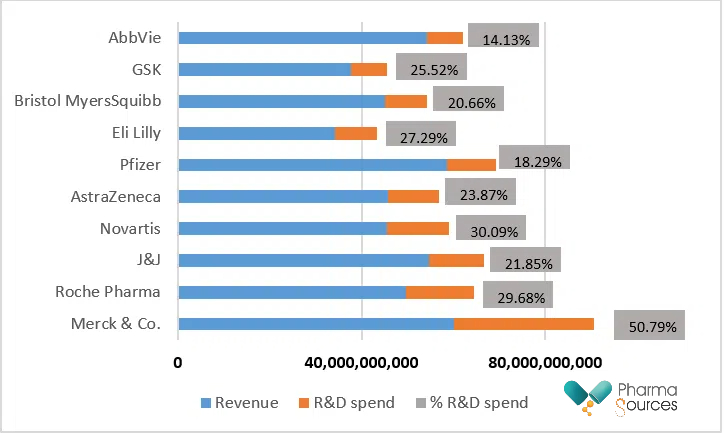
Figure. Global research based pharmaceutical companies revenue, R&D (%) spending by 2023
Traditional marketing practices
The idea that greater spending on innovation and R&D assures appropriate returns on investment rather than aggressive marketing strategies for existing products is reflected in the fact that, despite the figure appearing small, the top corporations spend the most on R&D relative to revenue. While no pharmaceutical company has been exempt, smaller businesses are more likely to employ this approach of strong marketing and poor innovation, which aims to recover income quickly rather than using innovation as a means of future-proofing their businesses.[2]
Drug promotion's effects on doctors' prescription practices since pharmaceutical marketing's effect has been increasing rapidly, frequently to the point of raising ethical questions. According to the 58 studies in a review's findings, there was either no link at all or a correlation between exposure to industry promotional material and increased prescribing frequency, expenses, or quality. Since there was no discernible advantage from the promotional activities, it was suggested that they be limited because they might shorten the time spent with patients and indirectly result in more expensive medications to recoup the costs of drug marketing.[3]
Tools for drug promotion such as medical representatives (MRs) and detailing staff using direct marketing. Due to the MR primarily commercial focus, there is little to no opportunity for scientific knowledge to be shared. Another responsibility of the MR is the process of gifting free samples of drugs to the clinicians. According to a research, the majority of doctors thought that the MRs would not affect their prescriptions. The WHO Ethical Criteria for Medicinal Drug Promotion were adopted by the World Health As...





























 (All Rights Reserved)