
Bivalent HPV Vaccine of Walvax Approved for Marketing: Who Will be the Leader of the Market Valuing RMB 100 billion?
On March 24, it was revealed on the official website of National Medical Products Administration that the self-developed recombinant human papillomavirus (HPV) bivalent (type 16/18) vaccine (yeast) of Zerun Biotechnology, the holding subsidiary of Walvax, has been approved for marketing (hereinafter referred to as "bivalent HPV vaccine").
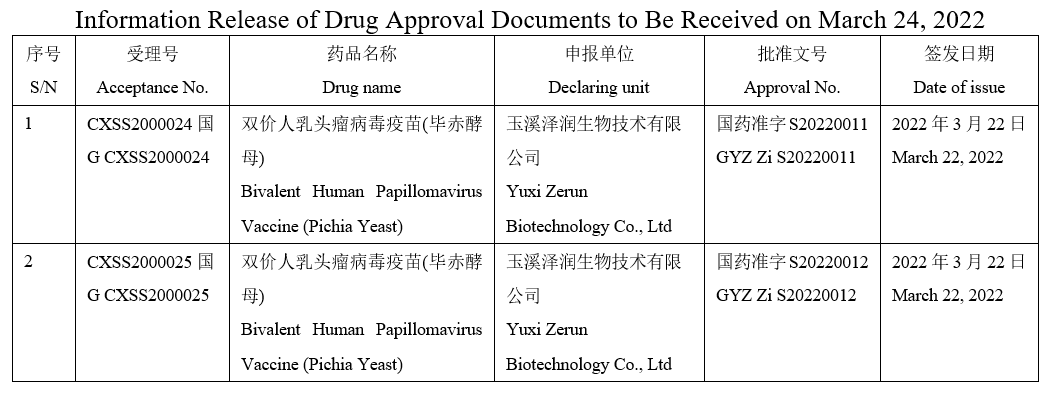
This is the second Chinese bivalent HPV vaccine to be approved for marketing. This increases the number of approved HPV vaccines marketed in China to five, namely GlaxoSmithKline (GSK) bivalent HPV vaccine Cervarix, Merck Sharp & Dohme (MSD) quadrivalent HPV vaccine Gardasil, Merck Sharp & Dohme nine-valent HPV vaccine Gardasil9, and Innovax bivalent HPV vaccine Cecolin. The two MSD vaccines are exclusively distributed by A-share listed company Zhifei Biological. With this, the "2+3" (two Chinese and three imported) pattern has been formally formed.
Cervical cancer: the only cancer that can be prevented by vaccination
Human papillomavirus (HPV) is an umbrella term for a group of more than 200 related viruses, and is one of the most common pathogens of reproductive system diseases. Most HPV viruses disappear in the body through immunization, but some high-risk HPV viruses, namely types 16, 18, 31, 33, 45, 52 and 58, may cause the cancer. Among them, HPV types 16 and 18 cause about 70% of cervical cancer cases worldwide, and HPV types 6 and 11 cause about 90% of anal and genital warts cases worldwide.
Just in 2020, 118,500 people were diagnosed with cervical cancer in China, of which 59,100 died. Although women are more susceptible and have more severe disease than men, this does not mean that HPV does not affect men. All HPV serotypes that can infect women can also infect men and cause serious diseases in men, including penile, anal, head and neck cancers.
HPV vaccination significantly reduces the incidence of cervical cancer and is recommended by WHO as a primary prevention measure for cervical cancer, enjoying significant economic benefits.
There are now three HPV vaccines commercially available worldwide: bivalent, quadrivalent and nine-valent, of which the bivalent vaccine can prevent HPV16 and HPV18 infections. According to international statistics, more than 70% of cervical cancers are caused by these two viruses. The quadrivalent vaccine can protect against the infections of HPV types 6, 11, 16 and 18; and the nine-valent vaccine is for nine HPV subtypes 6, 11, 16, 18, 31, 33, 45, 52, and 58. According to international statistics, the nine-valent vaccine can prevent 90% of cervical cancers.
High barriers to HPV vaccine R&D and short supply in Chinese market
In the 1980s, German virologists first confirmed the causal relationship between HPV and cervical cancer. However, it was not until the beginning of the 21st century that American scientists created the first vaccine against HPV, and in 2006, MSD quadrivalent HPV vaccine Gardasil was officially approved for marketing, a span of more than 20 years.
In China, the research team of Xiamen University and Innovax set up a project to develop Chinese HPV vaccine Cecolin in 2002, and declared the clinical trials in 2007, but it was not approved for marketing until 2019 and the first batch of vaccination was in May 2020, a time span of 18 years.
It is evident that there is strong R&D barriers for HPV vaccine production.
Before 2016, due to the delayed approval of imported vaccines and the fact that Chinese vaccines were still under development, women with the earliest awareness of cancer prevention had to go to Hong Kong for HPV vaccines at great expense, which once became a health trend for middle-class women in China.
In 2016, GSK Cervarix was approved for marketing in China. Following that, MSD quadrivalent HPV vaccine and nine-valent HPV vaccine were also marketed in China in 2017 and 2018 respectively. T...




























 (All Rights Reserved)