

Alzheimer's disease (AD) is a neurodegenerative disease affecting millions of people globally. AD is a chronic, progressive disease and with time, the patient’s cognition always deteriorates.
Apart from the typical symptoms of memory loss and cognitive impairment, AD is associated with a long prodromal period of 20 to 30 years during which no symptoms are seen. By the time the disease is diagnosed, significant, irreparable damages may have occurred.
The current treatment options offer symptomatic relief, but there is a huge unmet need for treatment with disease-modifying activity. The recent approval of Biogen’s aducanumab marks the beginning of a pipeline of therapies meant to target the underlying disease mechanism - but “one size may not fit all”. Hence, finding alternative treatment options and biological pharma products especially those which target the disease pathophysiology is the need of the hour.
Alzheimer’s disease drug pipeline
A distinct pathological feature of AD is the accumulation of amyloid β plaques in the brain which triggers neurodegenerative processes leading to memory loss and cognitive impairment. Another hallmark is the presence of tau protein tangles. Treatments targeting amyloid β plaques and phosphorylated tau protein have been investigated in several clinical trials albeit with limited success. This has compelled research towards targeting other targets such as inflammation, oxidative stress, infection, metabolism/bioenergetics, vascular factors, synaptic plasticity/neuroprotection, and gut-brain axis.
Currently, there are around 126 drug candidates for AD at various phases of clinical development. Of these, 28 agents are being tested in phase 3 trials – these include symptomatic agents as well as disease-modifying treatments. The list also includes 10 repurposed agents.
Some of the promising AD pipeline disease-modifying treatments in phase III clinical trials
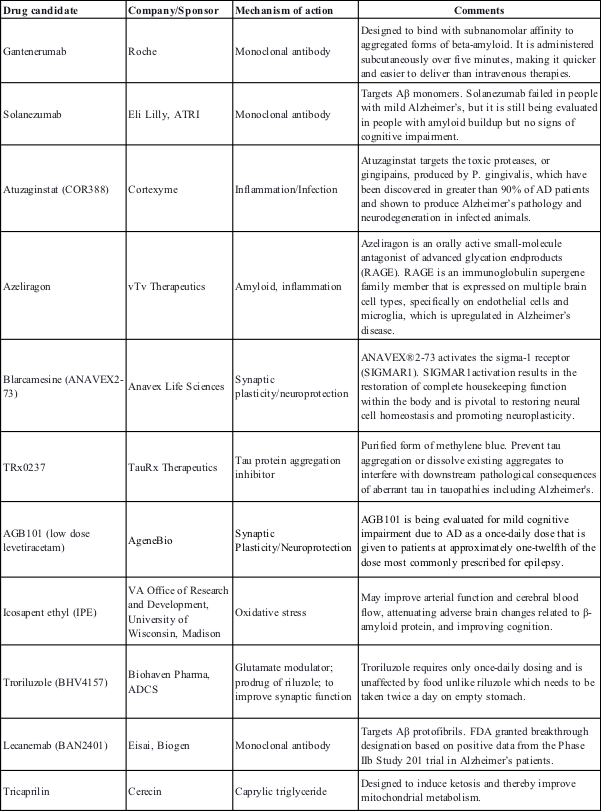
Alzheimer’s disease clinical trials
In the past few years, several treatments targeting various AD mechanisms especially amyloid β have been designed and tested, however, most have a disappointing track record.
Several reasons have been postulated for clinical trial failure. Some experts suggest that the dose used in the trials could be inadequate to achieve the therapeutic effect. Due to the differences in the blood-brain barrier between humans and animals, the dose used on animal models to predict human blood-brain barrier drug permeability may be insufficient to elicit a response in humans. Also, the doses used may result in unacceptable adverse effects. Several trials were stopped early due to inflammatory changes or microhemorrhages in the brain.
Another debate lingering AD trials is targeting the disease stage at which it is reversible. Most trials that failed target mild to moderate disease. A preclinical phase that precedes the onset of symptoms by a couple of decades is seen as a potentially reversible stage.
Though amyloid and tau are seen as potential targets, the stream of failed clinical trials indicates that other potential targets need to be explored. Also, research shows that amyloid β and tau protein act together synergistically in AD, thus, a possible approach would be to target both amyloid β and tau simultaneously.
Biogen’s aducanumab – The first therapy to target the underlying disease process
On June 07, 2021, the US FDA approved Biogen’s aducanumab (Aduhelm) for the treatment of AD.
Aducanumab is a monoclonal antibody that targets the amyloid-β and reduces amyloid plaques in the brain. Aducanumab is the first AD therapy approved to target an underlying disease mechanism.
The FDA approved aducanumab using the accelerated approval pathway based on the surrogate endpoint of reduction of amyloid-beta plaque in the brain. Aducanumab was evaluated in three different studies includi...

























 (All Rights Reserved)