

Today, contract research organizations (CROs) provide crucial services for almost any point along the drug pipeline.
What are CROs?
Contract research organizations (CROs) are outsourcing firms that undertake some of the more precise and focused R&D functions for the pharmaceutical, biotechnology, medical device industries, and also serve government institutions, foundations, and universities. Their specialization in certain aspects of the development process or specific therapeutic fields underscores expertise in those areas. They tend to be more mistake-proof, consisting of highly experienced professionals, offering preclinical, clinical, regulatory activities, and other research support services for drug development and commercialization. CROs are comprised of classes of unique technology, full-service, multinational, publicly-traded firms. Midsized CROs have the capability to act as site management contractors, which provide the clinical team, physician investigators, and patient support for clinical trials at the site. CROs can oversee and complete an administrative function in clinical trials or affiliate with an established project. Their main function is to close the “time-to-marketing” gap through effective application of innovation, engaging in a full spectrum service for the small biotech companies’ clinical trial activities. Therefore, the relationship is business, and the contract is for deliverables. (Table 1). (1)
Table 1: Examples of CRO Services
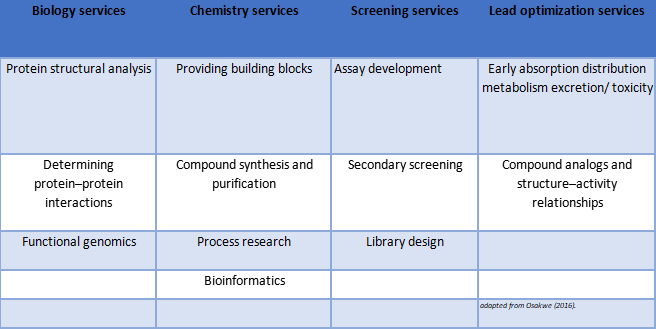
Moreover, a contract research organization (CRO) is a hired agent who has corresponding knowledge, technology and experience to conduct and complete tasks for a sponsor.
Types of CROs
There are different types of CROs, depending on the specific services they offer. Typically, CROs are segmented in discovery, preclinical, clinical, laboratory services, regulatory approval and data management. It is important to note that an individual CRO may specialize in one or more areas mentioned. Medium-sized CROs and larger may offer services ranging from discovery through clinical-stage trials all in one company.
Discovery
Drug discovery is the largest segment by service type and accounts for approximately 33%, of the total CRO market. (2) CROs specializing in drug discovery contain well-equipped laboratories focused on the discovery and preformulation/formulation sectors of the pipeline. Such companies tend to employ primarily chemists, scientists, and regulatory professionals and are focused on working with customers to quickly and efficiently move through the early steps of the drug pipeline.
Preclinical
CROs specialized in preclinical stages focus their efforts to studying the stability and efficacy of an API to the manufacturing of contracted drug products. Such companies will highlight services i.e. stability studies, a functioning vivarium, or pilot plants. They will have the systems in place to perform long-term multi-year experiments per contracted API.
Clinical
Clinical trials are complex, requiring study participants such as patients/volunteers, investigators/physicians, sponsors, nurses, quality oversight, and case management. CROs specializing in clinical phase have the personnel to set-up, site visit, run and document the entire process. Due to the high level of skill and regulation required for clinical-stage trials, it is not uncommon for CROs with a specialization in this area to not offer many other services in an effort to keep operating costs minimized. The fundamental theme of clinical phase is to apply what is revealed in preclinical experimentation and to bring the resulting safety and efficacy to clinics.
Laboratory Services
We know that laboratory equip...




























 (All Rights Reserved)