

What Are Biosimilars? How Are They Regulated?
Biologics and biosimilars are large and generally complex therapeutics produced from living organisms. A biosimilar is comparable to a biologic reference medical product already endorsed by the Food and Drug Administration (FDA) or equivalent regulatory agency. The main comparisons include structure, function, purity, and bioactivity. (FDA, 2022) Successful companies submit studies that demonstrate safety and effectiveness equivalent to the reference biologic. These studies include pharmacokinetics, possibly pharmacodynamics, immunogenicity assays, and any additional clinical studies needed. Biosimilars have the same quality standards as biologics. They are tracked post-marketing by pharmacovigilance to ensure continued safety.
Biosimilars are biologics, but they typically have a shortened developmental timeframe. They are by definition equivalent to a biologic already on the market. This regulatory pathway is similar to that used for medical device approval. Europe and North America led the way by developing the concept of biosimilars, but the Asia-Pacific (APAC) has taken the production lead.
The Chinese National Medical Products Administration (NMPA) released its first guidelines for biosimilars in 2015. China has subsequently rapidly expanded biosimilar production. The EU created the first biosimilar pathway in 2006, while South Korea and Japan implemented their frameworks in 2009.
Oncology Biosimilar Market Size, Companies
Oncology is a major application of biosimilars. From $4.19 billion in 2022 to $11.35 billion in 2026, the global market of oncology biosimilars will grow at a CAGR of 28.3%. The Asia-Pacific (APAC) region leads the way with approximately 55% of the biosimilar market, Europe holds 30%, the USA captures 14%, and the rest of the world has around 1%. (Yahoo!, 2022)
The APAC region is cost-sensitive, but generics are a cost-effective alternative to brand-name drugs, so biosimilars are particularly strong here. China and India together have at least a 77% share of the APAC biosimilar market. The breakdown is mainland China; 41%, India; 26%, South Korea; 15%, Taiwan; 8%, Japan; 4%, and Hong Kong; 4%. (Hagen, 2021)
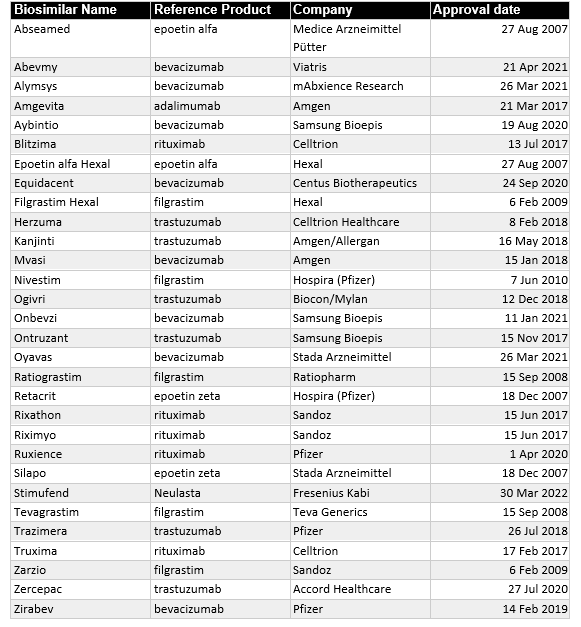
That said, the European biosimilar market is the most mature. Europe produced 84 biosimilars since the first in 2006, more than any other region or trading block. Unfortunately, 15 were withdrawn after approval, leaving a total of 70 biosimilars currently approved in Europe. Of these 70 biosimilars, 30 directly treat cancer (Table 1).
Table 1: EMA-approved biosimilars that directly treat cancer. Adapted from GaBi, 2022.
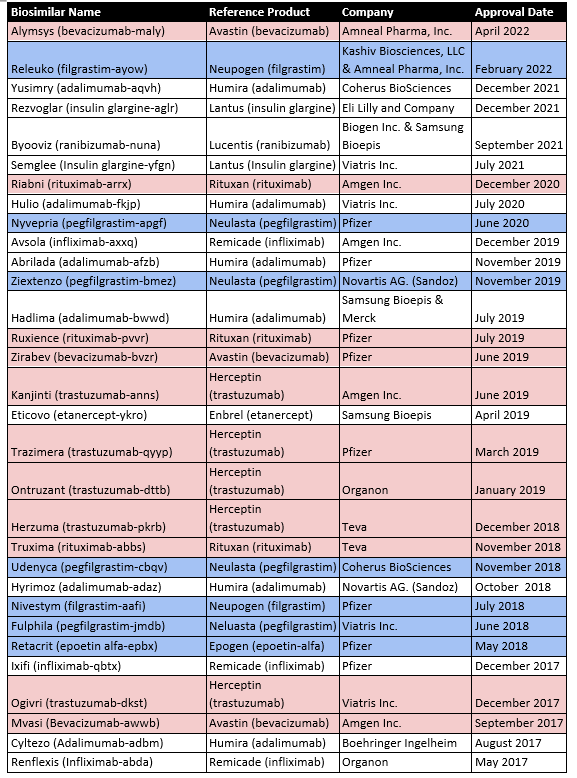
The first product approved via a biosimilar regulatory pathway in the USA was Zarxio (Filgrastim-sndz) in March 2015. The biologic Neupogen (filgrastim), a synthetic G-CSF, was the reference standard. As of May 2022, there are now 35 FDA-approved biosimilars, 19 of which have applications in oncology (Table 2).
Table 2: FDA-approved biosimilars. Red = anti-cancer, blue = can be used in a cancer context, white = non-cancer indications. Adapted from CDER, 2022.
 Read More































 (All Rights Reserved)